


- A Brief Overview of the Development History of Sulfuric Acid
1 The Development History of Sulfuric Acid
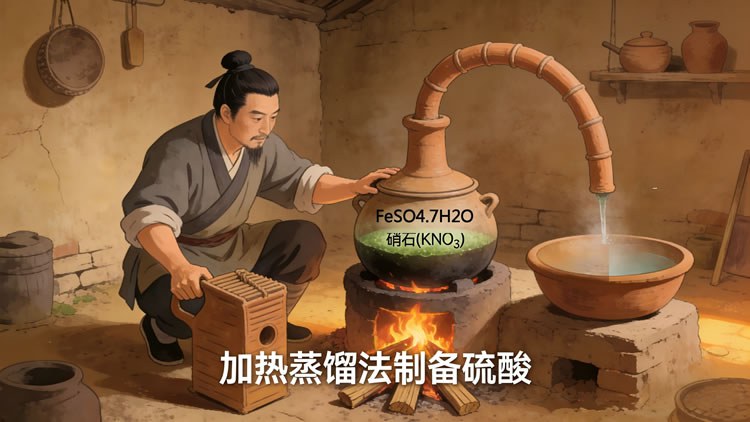
Around the 8th century, the Arab alchemist Jabir ibn Hayyan first recorded the method of preparing sulfuric acid by heating green vitriol (ferrous sulfate). The product, due to its strong corrosiveness and viscous form similar to oil, was named "vitriol oil".
During the Tang Dynasty of China (650 - 683), the alchemist Gu Gangzi recorded in the "Yellow Emperor's Nine Tripods Divine Elixir Classic and Secrets" a method for "extracting the essence from stone bile", which involved dry distilling copper sulfate (vitriol) to obtain dilute sulfuric acid, known as "green vitriol oil".
In the 17th century, French chemist Nicolas Lemery detailed a method for obtaining high-concentration sulfuric acid by distilling a mixture of green vitriol and saltpeter, which promoted the application of sulfuric acid in chemical experiments.
In the middle of the 18th century, the rapid development of the textile industry led to a sharp increase in the demand for dyes and bleaching agents. Sulfuric acid was the core raw material for preparing these chemicals, directly driving the industrial production of sulfuric acid. Around 1740, the British man, D. Ward, burned a mixture of sulfur and saltpeter in a glass container and reacted the resulting mixture of sulfur dioxide, nitrogen oxides and oxygen with water to produce sulfuric acid, which became the precursor to the later nitroso method of acid production. Six years later, the British man, D. Roback, built a 1.829 m³ lead chamber in Birmingham, and conducted the aforementioned nitroso acid production reaction in the lead chamber, becoming the world's earliest lead chamber-based acid production factory.
In 1827, French scientist J. L. Gay-Lussac proposed to install an absorption tower after the lead chamber, for the purpose of recovering nitrogen oxides from the exhaust gas and recycling them. In 1859, British scientist J. Glover suggested setting up a denitration tower before the lead chamber, for the purposes of preheating the raw gas, concentrating dilute sulfuric acid, and further absorbing nitrogen oxides. The nitrogen oxides were recycled, and the sulfuric acid concentration was increased to 76%. The combination of these two inventions increased the conversion rate of sulfuric acid from the initial less than 50% to over 80%, achieving the recycling of nitrogen oxides, while reducing raw material consumption and environmental pollution, making the lead chamber method the dominant process for global sulfuric acid production in the 19th century.
In the early days of lead-lined acid plants, the raw material used was sulfur. In the 1830s, both Britain and Germany independently developed acid production technology using pyrite as the raw material. Subsequently, the production of acid using smelting flue gas was also successful. With the expansion of the sources of acid production materials and the increase in production volume, the fertilizer and chemical industries were developed. By 1900, the world's sulfuric acid production had reached 4,200 kt.
The largest lead chamber in the world has reached 15,600 cubic meters (this chamber was built in 1916 by the Tennessee Copper Company in the United States). It operates in a four-chamber tandem configuration and produces 230 to 270 tons of sulfuric acid per day. However, the lead chamber method has drawbacks such as large equipment, low efficiency, excessive lead material consumption, and high investment.
In 1911, Austrian C. Opel built the world's first tower-type sulfuric acid production plant in Herushau. It operated with 6 towers and produced 14 tons of 100% sulfuric acid per day. Since then, the industrial development of sulfuric acid has entered the era of tower-based production.
In 1923, H. Peterson constructed a seven-tower acid production plant in Mazarovár, Hungary, consisting of one denitrification tower, two acid-forming towers and four absorption towers. He also made improvements to the acid circulation process and the gas-liquid contact method within the towers, thereby enhancing the production efficiency. Additionally, the former Soviet Union developed a more advanced seven-tower process.
In 1940, the industries of dyes, chemical fibers, organic synthesis, petroleum, and chemical engineering had achieved vigorous development. They not only increased the demand for sulfuric acid, but also placed higher requirements on the concentration of the acid (requiring substances like fuming acid, etc.). However, the acid concentrations produced by the lead chamber method (with an acid concentration of approximately 65%) and the tower method (with an acid concentration of approximately 76%) could not meet the needs of these various industries. Therefore, the development of the lead chamber method and the tower method was restricted. Instead, the contact method for producing acid saw rapid development.
The contact process was invented in 1831 by the British scientist P. Phillips. He first developed a method of generating sulfur trioxide by allowing sulfur dioxide to react with platinum powder or platinum wire in the air under high-temperature conditions. This process is later referred to as the contact process.
The contact process for acid production using platinum as a catalyst not only created conditions for the production of high-concentration sulfuric acid, but also because of the incorrect influence of German chemist K. Winkler at that time, it was believed that the mixed gas participating in the reaction must have the ratio of SO2:O2 = 2:1, and platinum materials were expensive, and they were prone to poisoning and losing their activity during operation. Therefore, the development of this process was relatively slow during that period.
By the beginning of the 20th century, significant progress was made in the research of the contact process technology. On one hand, the cause of platinum poisoning was identified and a method to prevent poisoning was found. On the other hand, the relationship between the equilibrium conversion rate and the gas components of SO2 and O2, as well as the reaction temperature was discovered. Thus, the influence of K. Winkler's erroneous concept was clarified. However, the cost of acid production using platinum as a catalyst was still relatively high. Despite the increasing demand for sulfuric acid in the industrial market, due to economic reasons, the development of this technology has been relatively slow.
In 1913, the German company BASF invented the vanadium catalyst. This catalyst not only had high activity but also was not prone to poisoning. Moreover, it was relatively inexpensive. In industrial applications, it soon demonstrated significant superiority and was rapidly promoted and widely used. It quickly replaced platinum and other types of catalysts, thereby significantly accelerating the development speed of the sulfuric acid industry. Subsequently, the contact process gradually replaced the lead chamber process. By the mid-20th century, over 90% of the sulfuric acid produced globally was produced by the contact process.
2 Early Development of Sulfuric Acid in China
The Tianjin Machinery Bureau was established in 1867. In 1874, a nitric acid washing device was built. The products of this factory were nitric acid, sulfonic acid water, and potassium nitrate. Sulfonic acid water is actually sulfuric acid, which was produced by the lead chamber method imported from abroad. The production scale was approximately 2 tons per day, and it was mainly used for manufacturing explosives.
The Jiangsu Pharmaceutical Chemical Factory was originally a small-scale gold and silver refining plant. The sulfuric acid equipment was purchased from Germany at a cost of 230,000 taels of silver. It used the lead chamber method for acid production. It started operation in 1897 and its maximum annual output once reached 2,000 tons.
The Jiangnan Manufacturing Bureau is located in Shanghai. It began to build the sulfonic acid (sulfuric acid) plant of its pharmaceutical factory in 1907 and started production in 1909. The acid was produced using the lead chamber method, with a capacity of approximately 0.68 tons per day.
The Hanyang Arsenal is located in Hanyang, Hubei Province. The sulfuric acid produced by this factory is also made using the lead chamber process. Construction of the factory began in September 1909, and its production capacity was approximately 400 tons per annum.
According to historical records, the Gongxian Military Factory in Henan Province, which began production in 1918, installed the first contact process acid-making device in China.
In the early days of our country's sulfuric acid plants, the raw materials used were all imported sulfur. It was not until 1932, when the Guangxi Wuzhou Sulfuric Acid Plant founded by Professor Li Dunhao began operations, that the plant adopted domestic pyrite ore (Yingde ore) as the raw material for the first time. By 1949, there were over 20 large and small sulfuric acid plants in our country. According to incomplete statistics, the total capacity of the plants was approximately 300 kt/a. Among them, the largest was the sulfuric acid production unit of the original Nanjing Yilin Ning Factory, which started operation in the mid-1930s, and the sulfuric acid plant of Dalian Chemical Factory. At that time, the maximum design capacity of a single series was 40 kt/a.
3 Iterative Update of the Sulfuric Acid Industry
After the mid-20th century, the sulfuric acid industry entered a period of rapid technological iteration. The core improvements focused on process optimization, large-scale equipment, and heat energy recovery,as well as automation and digitalization.
The first is the emergence of the dual-contact dual-absorption process. The traditional contact method only undergoes one conversion and absorption process, with a sulfur dioxide conversion rate of approximately 97%. There is still a significant amount of sulfur dioxide emitted in the exhaust gas. In the 1960s, the dual-contact dual-absorption process was industrialized: The raw gas passes through the first stage of conversion and absorption, and the remaining sulfur dioxide then enters the reactor for a second catalytic reaction, followed by entering the second absorption tower to complete the final absorption, increasing the total sulfur dioxide conversion rate to over 99.5%, significantly reducing exhaust gas pollution.
The second aspect is the large-scale and automated equipment. With the large-scale development of industries such as steel and non-ferrous metal smelting, the single series production capacity of sulfuric acid production facilities has increased from 100,000 tons per year to over 1 million tons per year. Core equipment such as converters and absorption towers are manufactured using new corrosion-resistant materials (such as carbon steel lined acid-resistant bricks and alloy steel). At the same time, a DCS distributed control system is introduced to achieve real-time monitoring and automatic adjustment of the production process, significantly improving production efficiency and safety.
The third is the waste heat recovery technology. During the production of sulfuric acid, a large amount of heat is released. Through a waste heat boiler, this heat can be converted into steam, which in turn can be transformed into electricity, achieving the recycling of energy. With the further development of low-temperature heat recovery technology, the heat recovery rate of the sulfuric acid plant has reached over 92%.
Fourth, automation and digitalization. The implementation of DCS (Distributed Control System) enables real-time monitoring and automatic regulation of production processes. Leveraging technologies such as IoT and digital sulfuric acid systems, intelligent monitoring and predictive maintenance are achieved across the entire production workflow, effectively reducing equipment failure rates and operational costs. Through material balance analysis, optimized raw material ratios and process parameters are established to further enhance production efficiency and product quality stability.
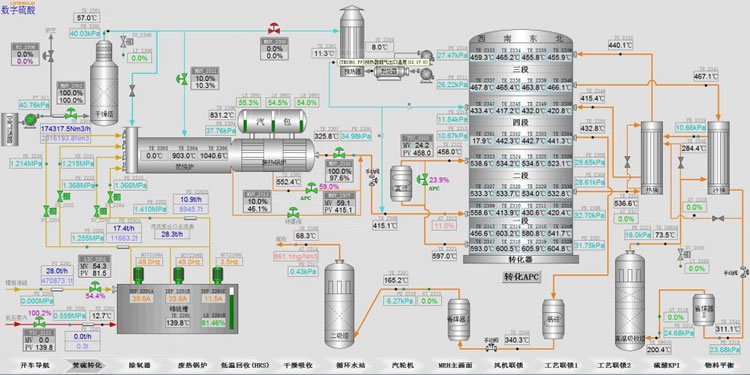
DCS Distributed Control System - Sulfur Incineration Conversion